
Effective conflict resolution is really just a form of good, clear communication where we utilize strong “I” statements and strive to define the problem by focusing on specific behaviors.
When any significant event occurs in our lives (be it happy or sad), we usually want to talk about it with those who are close to us.
Our response to any event has two parts: a feeling reaction, as well as a belief or way of thinking about the event. All of this influences the way we act or behave toward the person or persons involved in the original event.
The following chart outlines a pattern of how we respond.

Suppose a husband (who is happily married) becomes intensely involved in a work project and forgets to inform his spouse that he will be late for a dinner engagement.
- EVENT: He is an hour late, and this becomes the event.
- FEEL: The feeling reaction of the wife is most probably one of worry, anger, and hurt. This is because she is sitting at a restaurant not understanding why he isn’t.
- THINK: She may believe or think that he has been involved in an accident, that he simply doesn’t care, or simply that he’s been rude.
- DO: As a result she may act in a way that shows her spouse anger, hurt, and displeasure. Her behavior then becomes an event for the other spouse.
Applying the Feeling, Think, Do Pattern
Use the following framework when dealing with conflict:
- EVENT: Describe the event, focusing on the behaviors of persons involved.
- FEELING: Describe how you felt.
- CONSEQUENCE: Describe the consequence of the event.
- THINK: Describe what you are thinking about the behavior in the event.
- WHAT YOU WANT: Describe what you want to happen differently next time.
So for the example above, the wife might say:
When you didn’t call to let me know you’d be late (EVENT), I felt angry (FEELING) because I had to eat alone after preparing a meal for two of us (CONSEQUENCE).
I thought maybe you didn’t respect me since you didn’t call (THINK).
I want you to agree to be more considerate the next time. Does that seem reasonable to you? (WHAT YOU WANT)
This also works for a positive event:
When you brought be flowers yesterday (EVENT), I felt happy (FEELING) and it really made my day (CONSEQUENCE).
It really shows that you care for me (THINK).
You can send me flowers any time you want, and who knows, maybe I’ll surprise you one of these days (WHAT YOU WANT).
Good Communication in Practice
Print out or open the “Good Communication in Practice” worksheet. Take some time to think of a positive event and a negative event that happened this past week that involved both you and your significant other in which he or she played an active role.
- First, describe the event in the “event” column.
- Next, construct a description of the event, placing emphasis on his or her action.
- Then, describe how you felt, what you were thinking about the event, and what you want to see happen in the future.
When you are finished with the worksheet. Share your responses with your significant other. Together, commit to applying this framework in your next conflict.
Download and complete the worksheet:
Complete the worksheet in Microsoft Word.
Download and print the worksheet using the Adobe PDF Reader.
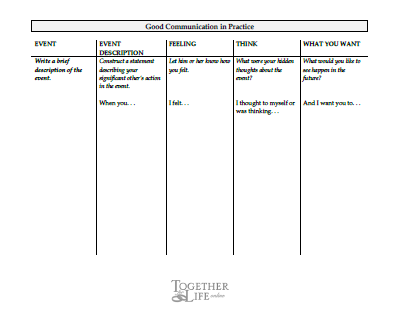
Download the Worksheet: "Good Communication in Practice"
All content, activities, and reflection questions are taken from the Marriage Preparation book, Before “I Do”, published by Ave Maria Press. For more information about this and other marriage resources, visit www.avemariapress.com.
Did you find this page via a link from a friend?
This eRetreat session is a part of the “Conflict and Communication” eRetreat series at Together for Life Online. It is completely free. Sign-up here if you are interested in experiencing it for yourself.